
How to Talk About Medical Recovery When Someone Is Resistant to the Idea
Suggesting medical recovery can be difficult, especially when the person you care about reacts with immediate resistance. This reaction is common among capable, rational people who are used to managing pressure and making decisions. In most cases, the pushback is not about rejecting help or denying a problem. It is about protecting identity, control, and professional standing.
Pressure and logical arguments often make this resistance stronger, not weaker, because they imply loss of autonomy. Understanding this dynamic is the first step in how to suggest medical recovery without escalating tension. This article explains how to approach the conversation thoughtfully — focusing on perspective and framing rather than persuasion or force.
Why Resistance Is a Natural Reaction, Not a Rejection of Care
Resistance to medical recovery is usually a protective response. For people who value independence and performance, the idea of recovery can feel like a threat to how they see themselves: capable, reliable, in control. Accepting help may seem to imply weakness, loss of status, or a shift in identity they are not ready to make.
There is also a fear of losing autonomy. Medical support can be perceived as something that takes decisions away, restructures time, or introduces labels that are hard to undo. In this context, resistance does not mean the person is ignoring their health. It means they are defending control over decisions, pace, and self-image. Recognizing this helps keep the conversation calm and non-confrontational, rather than turning it into a debate about whether help is necessary.
Why Medical Rehabilitation Is Often Misunderstood
The term “rehabilitation” is often heard as a signal of severity or loss of status, not as a medical framework. For high-responsibility people, it can sound like being taken out of action, managed by others, or labelled in a way that affects professional identity. That reaction is common — and it can block a useful form of care.
In medical terms, structured recovery is not limited to major injury. It can be relevant when baseline function declines under prolonged strain, when fatigue or cognitive capacity does not rebound with rest, or when symptoms remain unclear and fragmented. The core idea is clinical structure: doctor-led oversight, a single medical overview, and coordinated input when multiple factors are involved — with continuity over time rather than isolated visits. At Swiss Medical Center, this is delivered with discretion and secure communication as operating standards.
How to Introduce the Idea Without Triggering Pushback
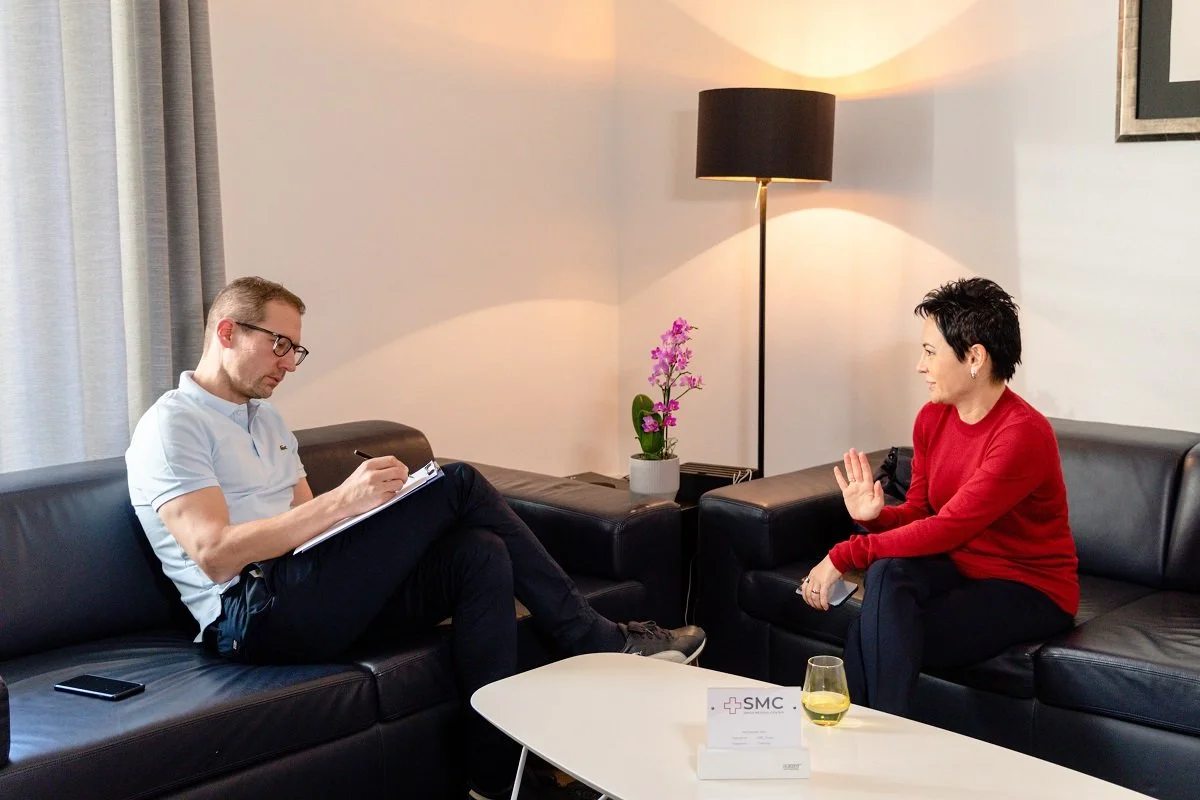
Pushback usually increases when the conversation feels like a verdict. Direct pressure, problem-solving mode, or a series of “reasonable arguments” can sound like an attempt to take control away. For high-performing people, this triggers a defensive response rather than openness.
What tends to lower resistance at the level of communication logic:
Timing: conversations held outside moments of crisis or exhaustion are easier to process;
Framing: discussions about clarity and support feel safer than conversations framed as “treatment”;
Tone: observation and concern reduce defensiveness more effectively than evaluation;
Shared goals: focusing on function, clarity, and autonomy keeps the discussion aligned.
This is why questions and observations often work better than conclusions. Talking about medical recovery becomes easier when the logic is “we are trying to understand this together,” rather than “this needs to be solved now.”
What Language Increases Resistance (and What Lowers It)
Resistance often rises or falls based on what the language signals: judgment or support, control or autonomy. The goal is not to find “perfect phrases,” but to avoid framing that turns health into a status issue.
What lowers pushback is not wording polish — it is intent. Language that implies pressure, diagnosis, or loss of control triggers defense. Language that protects autonomy and focuses on clarity keeps the conversation medical, not personal, which is especially important for high-responsibility individuals.
When Structured Medical Recovery Makes Sense to Suggest
Structured medical recovery is usually relevant when the pattern repeats and clarity does not emerge on its own. The issue is not dramatic symptoms, but loss of baseline and unreliable recovery — a common profile in recovery from overwork and burnout.
Checklist: Patterns that often justify considering structured support
persistent fatigue that does not resolve with rest or time off;
cognitive decline under normal workload (focus, speed of thinking, decision tolerance);
repeated short breaks that reduce pressure but do not restore function;
growing effort required to maintain baseline performance and routine tasks;
unclear or conflicting medical input across separate consultations;
recovery that feels unpredictable, with setbacks that lack a clear trigger.
In these situations, the practical value is a single medical overview and coordinated reassessment, so the person is not left to manage uncertainty alone.
What Support Looks Like in a Medical Recovery Context
Medical recovery support is easiest to accept when it is understood as medical responsibility plus structure. The aim is to reduce uncertainty and remove the need for the person (or their family office) to carry the clinical and logistical burden alone.
Core elements in a medical recovery context:
Doctor-led oversight: one accountable medical lead who holds the clinical thread over time;
Structured assessment and monitoring: patterns are tracked and reassessed, rather than guessed from single moments;
Coordination instead of isolated recommendations: inputs are aligned so priorities are clear and conflicts are minimized;
Gradual restoration of function: the focus is on returning reliability and baseline capacity, not on labels or quick conclusions.
This model is especially relevant when progress is uneven and the “next step” remains unclear.
How Swiss Medical Center Supports Medical Recovery Without Stigma
Swiss Medical Center is designed for people who need medical recovery handled with the same professionalism as their work life: clear responsibility, protected privacy, and minimal friction. The clinical lead is Dr. Andreas — a board-certified internist and cardiologist with 25 years of experience, trained in Switzerland, the USA, and France, with additional accredited focus in sports medicine (SGSM/SEMS). His approach combines preventive and integrative perspectives with practical, evidence-based decision-making.
For rehabilitation and recovery, SMC provides doctor-led oversight and a single clinical overview, then coordinates the right specialist input through a trusted Swiss partner network — so the patient is not managing multiple threads alone. Discretion is an operating standard: no public case disclosures, secure communication, and ethical referrals. For international or high-profile clients, recovery can be paired with concierge coordination and luxury accommodation options, including partnerships such as The Dolder Grand Hotel for wellness-oriented support alongside medical oversight.
FAQ
-
No. Medical rehabilitation can also be relevant when baseline function declines under prolonged strain, recovery becomes inconsistent, or symptoms remain unclear despite rest. The focus is structured medical oversight and restoration of capacity, not severity alone.
-
Resistance usually reflects protection of autonomy and identity. Many people fear labels, loss of control over decisions and time, or the implication that they can no longer handle their responsibilities.
-
Time off reduces load, but it does not create a medical overview or coordinated decision-making. Medical recovery adds structure: doctor-led responsibility, assessment in context, and aligned next-step logic when progress is unclear.
-
Yes, especially when repeated breaks do not restore baseline performance or cognitive capacity. In that context, the goal is clarity and a structured path forward rather than hoping recovery happens on its own.
